Featured Artists
Finding Faces: Zedene Omondi’s Journey in Portrait Drawing and Artistic Expression

Mar
Introduction
For artist Zedene Omondi, art has always begun with a face. Before mastering composition, perspective, or anatomy, he was captivated by human expression—the subtle curve of a smile, the tension in a brow, and the quiet depth in someone’s eyes. Portrait drawing evolved from a simple practice into a profound method of understanding people. Today, Omondi specializes primarily in portraiture, dedicated to capturing not just a physical likeness, but the emotion, personality, and unique story embedded within every face.
Early Beginnings
Omondi’s artistic journey began humbly with simple sketches in the margins of notebooks. He was a constant observer of people—family members, friends, and strangers on public transport—mentally tracing the lines of their features. Fascinated by the fact that no two faces are alike, he noticed even identical twins carry subtle differences in expression and energy.
Initial drawings were rough and disproportionate, with eyes placed too high on the forehead and features lacking structure. However, these imperfections became a driving force rather than a deterrent. Determined to understand the mechanics of a realistic face, Omondi began a deep study of proportions: the alignment of the eyes, the spacing between features, and the underlying skull structure. Over time, copying photographs transformed into intentional practice, with every portrait serving as an opportunity to improve.
Discovering a Signature Style
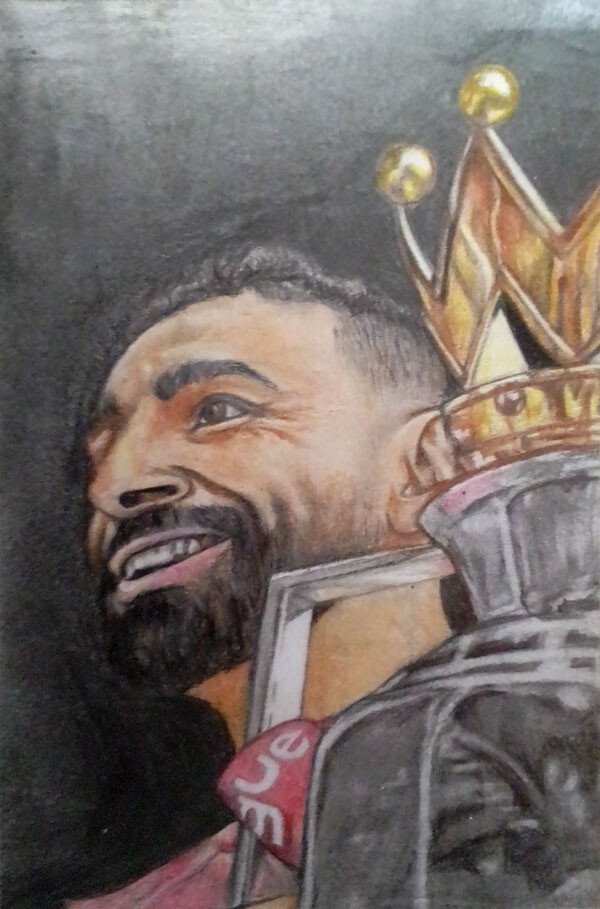
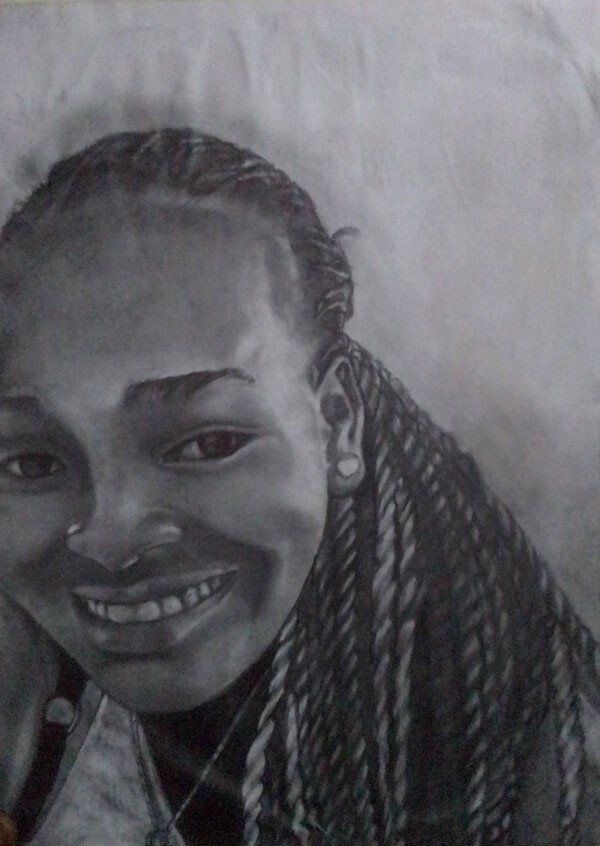
As his technical skills sharpened, Omondi began experimenting with various mediums. Graphite pencil quickly became the foundation, prized for its control and ability to create soft skin gradients and sharp shadows. Later, the exploration of colored pencil introduced a dramatic depth to the work, allowing for intense contrast in the eyes and defined structure in the cheekbones.
This experimentation led to a distinct style leaning toward realism, characterized by a focus on intricate detail—eyelashes, subtle skin textures, and reflected light in pupils. However, the ultimate goal extended beyond technical accuracy to achieve emotional realism. Omondi discovered that the eyes are often the emotional anchor of a portrait; if the eyes are convincing, the entire drawing breathes with life. Consequently, his work became recognized for its expressive eyes and strong value contrast.
The Creative Process
Every portrait begins with a period of intense observation. Before putting pencil to paper, Omondi carefully studies reference images, analyzing light direction, shadow placement, facial planes, and expression. The goal is to discern the mood and feeling of the subject.
The process typically starts with a light structural sketch to map out proportions. Accuracy at this stage is critical, involving careful measurement of distances and alignment before moving on. The next stage—shading—is where the portrait transforms from a flat outline into a dimensional form. By building layers gradually from light to dark, smooth transitions in skin and deep shadows in hair are achieved. Patience is essential, as rushing can flatten the image. Finally, highlights and contrast are refined. Small adjustments, such as sharpening an edge or deepening a shadow, elevate the drawing. Stepping back frequently helps view the portrait as a whole, ensuring a cohesive result.
Artistic Inspirations
Omondi finds inspiration everywhere, but everyday people inspire him the most—elderly faces lined with experience, children with curious expressions, and individuals caught in candid moments. Social media has also exposed him to a wide range of contemporary hyper-realistic portrait artists, whose work motivates continuous refinement. However, he views art as a personal evolution, not a competition.
Photography is another major source of inspiration, particularly dramatic side lighting that enhances facial structure and creates compelling shadows. Black-and-white references are especially favored as they simplify color, allowing focus on value and form. Ultimately, the deepest inspiration stems from human emotion itself. Joy, vulnerability, resilience, and contemplation are the intangible qualities Omondi strives to capture, making a portrait a visual interpretation of a person’s presence rather than a mere copy of a photograph.
Challenges and Artistic Growth
Portrait drawing is a demanding discipline. The human eye is incredibly sensitive to facial inaccuracies, and even a slight misplacement of features can diminish a portrait. Learning to see mistakes objectively has been a significant challenge for Omondi. During moments of stagnation, he revisited fundamentals—anatomy studies, value scales, and timed sketch exercises—proving that improvement often comes from strengthening the basics.
Overcoming perfectionism has also been a crucial part of his journey. While portraits require precision, art also requires freedom. Omondi has learned that sometimes the smallest imperfections add character, and letting go of the need for flawlessness has resulted in more expressive and enjoyable work.
Notable Achievements
A proud achievement for Omondi has been witnessing others connect emotionally with his work. When someone shares that a portrait truly captures a loved one’s essence, it reinforces the purpose behind his practice. Completing commissioned portraits has pushed him to meet high expectations, developing professionalism, time management, and clear communication skills. Beyond commissions, personal milestones—such as mastering a challenging expression or realistic hair texture—have been equally meaningful. Sharing his work publicly for the first time was a major step that required vulnerability but ultimately opened doors to valuable feedback, encouragement, and a creative community.
Artistic Philosophy
Omondi believes portrait art is a dialogue between creator and subject, requiring empathy. When drawing someone, he tries to imagine their story, searching for the human element behind the image. For him, art is not about perfection; it is about presence. A successful portrait feels alive and invites the viewer to pause and connect. He views mastery as a lifelong journey, not a destination, with endless techniques and emotional depths to explore.
Future Aspirations
Looking ahead, Omondi hopes to expand his portrait work into larger-scale pieces and experiment with mixed media, combining realism with subtle abstract elements. Building a stronger artistic presence through exhibitions, online platforms, or teaching is also a goal. Teaching, in particular, would offer a way to share his knowledge and continue growing through collaboration. Ultimately, his goal remains simple: to keep improving and to keep capturing the humanity in every face he draws.
Conclusion
Art has taught Omondi patience, discipline, and observation. Portrait drawing, in particular, has taught him empathy. Every face holds a story, and through his work, he aims to honor those stories—one pencil stroke at a time.